
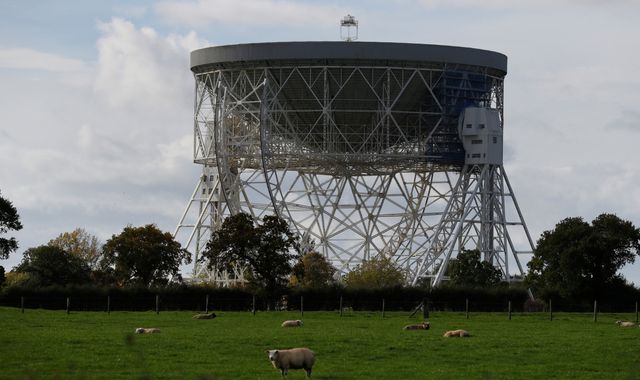
The UK's largest telescope has been put at risk of shutting down after its funding was withdrawn.
The Lovell telescope, which has stood at Jodrell Bank Observatory in Cheshire since 1957, could be forced to cease operations when it stops receiving public money at the end of March 2028.
The instrument, which has a diameter of 76.2 metres, is the world's third largest steerable radio telescope and is part of the e-Merlin UK-wide network of telescopes operated by the University of Manchester.
But on Monday, UK Research and Innovation (UKRI), a government-funded body, said that e-Merlin would "not be prioritised" for further funding after its current agreement ends.
The decision has been met with outrage from critics, including physicist and TV personality Professor Brian Cox. He said: "These devastating and irreversible cuts are a legacy from a series of hasty and ill-considered decisions taken by UKRI, overseen by a government department that no longer exists."
Professor Cox added: "The damage to the UK's science base has already been substantial, and I am sure the new ministers responsible will want some time to review the situation. I am astonished that UKRI are still ploughing ahead, and not working with the Burnham government to find a solution."
Paul Howarth, president of the Institute of Physics, described it as "yet more bad news for physics following a series of cuts over this year and the last to UK science".
He added: "These cuts will come as a terrible blow to the scientific community and do real damage to the UK's reputation as a place to research and innovate.
"Despite reassurances, physics has not been protected, crucial facilities remain under threat and jobs are being lost. Scientific capability that has taken years to build up is being put at risk by these decisions."
Professor Sarah Sharples, the dean of science and engineering at the University of Manchester, said: "We are working... extremely actively to find alternative sources of funding from government, from industry, from charities, from philanthropy.
"But, if we don't find those alternative sources of funding, then there is a risk that, as of the end of March 2028, then the Lovell Telescope will not be an actively functioning scientific facility for radio astronomy."
Read more from Sky News:
UK prepares for fourth heatwave
Carly Simon reveals Parkinson's diagnosis
Flash floods and typhoon hit China
In a statement, the UKRI said officials had "undertaken a rigorous prioritisation process to focus investment on the areas that will deliver the greatest long-term scientific capability, impact and value for the UK, while maintaining a sustainable PPAN (particle physics, astronomy and nuclear physics) portfolio".
It also said the decision was "the result of a comprehensive, evidence-based prioritisation process".
"The current e-Merlin funding agreement runs until March 2028, providing time to explore alternative funding arrangements," the UKRI added.
Jodrell Bank had a pioneering role in the development of radio astronomy, along with its work tracking spacecraft in the early space race, and its research into quasars, pulsars and gravitational lenses.
The Mark II, 42ft, and 7m Telescopes are also part of the e-Merlin network operating from Jodrell Bank.
The Jodrell Bank Centre for Engagement is regarded as a separate entity and is not thought to be at risk from the cuts. It was designated a UNESCO world heritage site in 2019.

(c) Sky News 2026: UK's largest telescope could be shut down after funding cut
 Local news content from CItiblog - read more at
  Two people dead after diving trip to Loch Fyne in Scotland
 Tate brothers to remain in jail for at least two more weeks ahead of next court appearance
 Teenager denies piloting dinghy with 167 people on board across channel
 Wildlife presenter and comedian Bill Oddie has died
 Police 'conducting enquiries' after Polanski shared post appearing to threaten Farage
 Man questioned by police over mum-of-two's 'unexplained' death in Lancashire
 The King's most senior aide, Sir Clive Alderton, steps down after 20 years of 'tireless' service
 Father and daughter die after getting into difficulty at Cornwall beach