

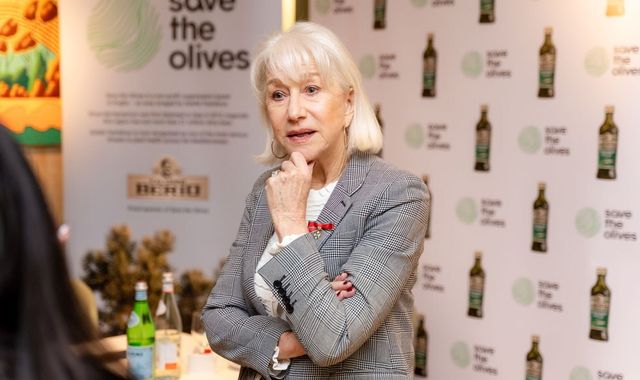
What do an Oscar-winning actress and your grocery bill have in common? More than you might think.
This particular drama is set in the rolling groves of Puglia, where olive trees have stood for centuries before a quiet crisis began unfolding 18 years ago.
That's when Xylella, a bacterial disease, is thought to have arrived from Costa Rica. Since then, it has destroyed 21 million trees - and no cure has yet been found.
Dame Helen Mirren has witnessed all this up close. The olive grove at her farmhouse in Puglia was decimated by Xylella, forcing her to rip out around 100 trees and replace them with a resistant variety.
Spurred on by the lack of assistance and understanding of the disease, the 80-year-old set up the charity organisation Save the Olives to share information and figure out a way to fight the disease.
The non-profit is now focused on creating a new species of olive tree that is resistant to Xylella and able to create a rich-tasting olive oil.
It has funded a specialised greenhouse and bought a field to allow experts to carry out experiments on the species later this year.
If successful, the hope is Italy's olive industry can be saved - and a knock-on effect could be lower food prices in the UK and across Europe.
"So many of these orchards were small orchards owned by a family," Mirren told the Money blog.
"They were helpless. They didn't have the finances to sort of fight this. And the whole world seemed to be ignoring it.
"It's the saddest, most terrible thing, to see a tree like that, completely dead. It's just awful."
Read more:
Supermarkets 'taking mickey' with olive oil prices
It is thought Xylella first arrived in Italy in 2008 on an infected coffee plant, but it was not recognised by Italian authorities until 2013.
Xylella contributed to Italy's olive oil output dropping from 600,000 tonnes in the 1990s to 250,000 tonnes in the 2020s, according to the International Olive Council.
That, along with poor harvests in Spain, has helped push up prices for consumers for whom olive oil is now a staple.
"I love the fact that olive oil has become so much part of British cuisine," Mirren said. "When I was a child, you could only buy olive oil in Boots to pour down your ears when you had an earache. It was a medicine; it wasn't anything to eat."
She added: "People are paying an awful lot of money for a very fancy label, basically. They will pay less when we eradicate the disease, definitely."
Filippo Berio boss Walter Zanre said he didn't see the disease creating a global supply problem, providing Spain continues to see its crop improve, but he does think it will "inevitably push up the price" of Italian food.
He called on the Italian government and the European Union to do more.
"They should be helping those small growers, and nothing has been done. They ignore it as an industry," he said.
The Italian government has previously made grants available to small farmers affected by the disease.
Are we going to get back to low prices?
Zanre doesn't think we're going to see prices come back down to the lows of the 2010s, but he does think we could get back within 10% to 15% of those prices.
With war in the Middle East causing energy prices, production costs and high inflation fears to spike, he warned that "everything costs more, so we're never going to get back to where we were".
But, he added, "all it needs is one big crop and a glut and everything will be back on the floor again".
With higher prices causing Britons to slightly move away from expensive products, Zanre said Filippo Berio was hoping to boost sales with new innovative products and sales techniques.
Read more from Sky News:
Why don't experts agree on overpaying your mortgage?
The government's political dilemma on student loans
The company is diversifying its portfolio further, with vinegars, pestos and pasta sauces already seeing huge growth. It is launching more balsamic glazes and is looking to expand into salad dressings and "mayonnaise-type products".
It recently introduced a squeezy bottle of olive oil, which Zanre expects is a "bit of a niche" product that will "never really come alive" but hopes will reel in a younger audience.
To do that, it is going to start selling a bundle of squeezy bottles on TikTok.
"It's heritage, quality, authenticity and those are all the values that come from those dark glass bottles. I don't think a squeezy bottle gives you heritage and authenticity, but it does address a new, younger consumer," he said.

(c) Sky News 2026: The curious link between Helen Mirren's garden and food prices
 Local news content from CItiblog - read more at
  Church warden serving life for murder of university lecturer has conviction quashed
 GDP grows by surprising amount but it could be last uptick for a while
 Meghan says she was 'the most trolled person in the entire world'
 Teens staying silent on politics for fear of being 'cancelled'
 Mark Kleinman blog | Political intelligence provider DeHavilland's owners plot sale
 Fears government cash will come too late to save manufacturing jobs
 Police warn protesters - and say Epsom rape suspects can't be identified
 Two people arrested after attempted arson attack on synagogue in north London