
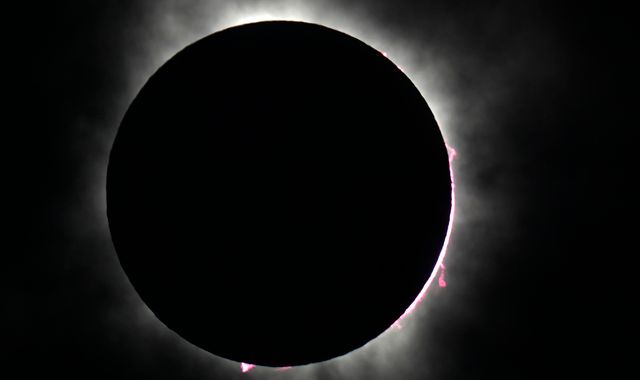
Day will briefly turn into night for parts of Europe next month as the continent experiences its first solar eclipse in nearly three decades.
The rare celestial event on Wednesday 12 August will see the moon pass directly between the Earth and the sun, briefly plunging people in parts of Greenland, Iceland, northern Russia, Spain and a small corner of Portugal into darkness, according to NASA.
The UK will only experience a partial solar eclipse, but it's still set to cover the vast majority of our view of the sun.
Here's everything you need to know.
Daylight to twilight - what will you see in the UK?
It's going to be the first total solar eclipse visible from Europe since 1999, when one could be seen from most of Cornwall and Devon.
This time the UK and Ireland will lose sight of around 90% of the sun rather than all of it.
The partial eclipse will mean the UK and Ireland do not experience total daytime darkness, but instead see what appears to be a giant bite taken out of the sun as the moon obstructs our view.
At the partial eclipse's maximum, enough of the sun will be covered to make a noticeable difference in the temperature and light levels, according to the Royal Observatory Greenwich, making it feel close to dusk or dawn despite the daylight hour.
The clearer the skies are that day, the more drastic the shift will feel. Additionally, the further south west you are, the more of the sun will be covered.
You will initially see first contact - when the moon starts to cover the sun. Then you will see its maximum, when most of the sun is covered, and finally the end of the eclipse.
In London, the maximum is set to be around 90%, while those in Cornwall will see 95% and people in the south-western tip of Ireland could see almost 97.7% coverage, the observatory says.
A partial eclipse will also be seen in other parts of Europe, Canada and parts of northwestern Africa.
When will it happen?
It will be early evening on 12 August when the eclipse begins in the UK. Here's the timeline:
Where can I see the total eclipse?
You will have to join the many tourists expected to travel abroad on 12 August, as the path of totality - where the moon completely covers the sun - begins over Greenland before crossing Iceland and ending in northern Spain and the Balearic Islands.
According to NASA, a small, remote region in northern Russia will experience totality at midday, while for those in Greenland and Iceland it will come in the late afternoon or early evening.
Read more:
UK bird species could be first lost to climate change, conservationists warn
Oldest woman to travel into space dies aged 87
In Spain and the very northwestern tip of Portugal, the sun will not be fully eclipsed until the late evening, shortly before sunset, NASA adds.
The sun will only be fully eclipsed for less than two minutes for the majority of those who manage to see it, though that extends to about 2.5 minutes for anyone near the very centre of the eclipse path in Greenland, Russia, or the North Atlantic.
How to view the eclipse safely
Even during an eclipse, looking at the sun directly can damage your eyes, except for in the brief moment when the sun is completely covered during totality - and we will not have that at all in the UK.
You will need proper eclipse glasses to look safely, which are "thousands of times darker" than sunglasses, according to NASA.
But you need to make sure they work, as bogus retailers capitalise when an eclipse is due and you may be duped into buying a counterfeit pair.
The American Astronomical Society advises these three steps to check if your glasses are safe:
• Put them on indoors and look around. You should not be able to see anything through them, except perhaps very bright lights, which should appear very faint through the glasses.
• Take them outdoors in sunlight and try them on again. You still should not be able to see anything, except possibly a slight reflection of the sun off a shiny surface or a puddle.
• Now glance at the sun through them for less than a second. You should see a sharp-edged, round disk that's comfortably bright without being overwhelming.
If you are photographing the eclipse, use a certified solar filter on your camera or telephoto lens.
A tripod can help keep images steady in low light, while wider shots showing the changing landscape and people's reactions often produce more memorable pictures than close-ups of the sun.

(c) Sky News 2026: Europe's first total solar eclipse in almost 30 years: What you need to know
 Local news content from CItiblog - read more at
  Top Boy actor Micheal Ward sobs as he's found not guilty of raping woman in a car
 Sam Fender and Olivia Dean overtake Wet Wet Wet with record-breaking chart run
 Police investigating Andrew Mountbatten-Windsor to speak to Virginia Giuffre's family
 Brothers jailed for 1984 murder during violent spree against men they thought were gay
 Arthur Fery defeated in Wimbledon semi-final by Germany's Alexander Zverev
 Fox rescued after spending days with head trapped in bottle
 Funeral for PC Jess Turnbull, 19, who died in line of duty, held in Newcastle
 Vape flavours and packaging that are 'attractive' to children could be banned under reforms