

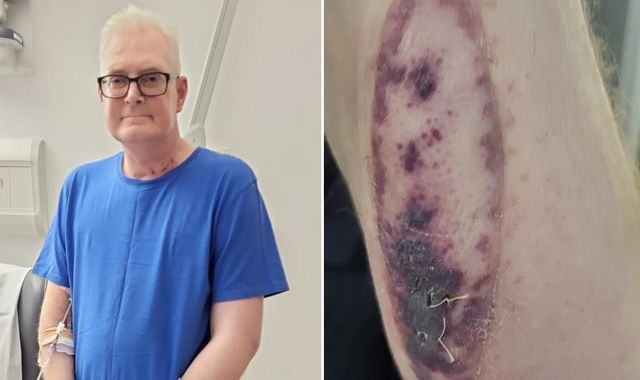
A skin patch from an organ donor helped a patient discover his body was rejecting his new lung, leading him to get swifter treatment.
Darren White was one of the first lung transplant patients to have a patch from their donor grafted onto the skin.
The 53-year-old was given steroids when tests showed his body was rejecting his lung three months after the operation.
Over a year later, he is doing well and said he can now be "more of a dad" to his toddler, Daniel, because he can walk and take him to the park.
Experts leading the Sentinel trial said the skin flap, which is grafted on to patients' forearms at the same time of their lung transplant, acts as a window.
Scientists believe the skin reacts earlier than other organs and is more visible, meaning medics can treat rejection as soon as a rash appears in order to cut the risk of permanent damage.
So far 10 patients have received 10cm by 3cm patches from their organ donor as part of the study.
In 2024, the former bus driver was diagnosed with lung fibrosis, which causes the lungs to become scarred and leads to breathing difficulties.
He had a transplant later that year and said he did not hesitate to agree when approached about the Sentinel trial while he was on the waiting list.
"Anything that might help to avoid rejection was worth a try," Mr White, from Stockton-on-Tees, County Durham, said.
"Rejection is the biggest fear of any transplant recipient, so having something that might be able to catch it much sooner than otherwise was really appealing."
Lung rejection is typically hard to detect because it can involve blood tests, biopsies and X-rays, according to NHS Blood and Transplant (NHSBT).
Rates of rejection are typically highest in the first three to six months post-surgery and occur in almost a third of patients.
Three months after his transplant, Mr White noticed a purple rash on the flap and sent photos to doctors.
A biopsy showed mild rejection, and he was treated with steroids.
Read more from Sky News:
Taxi driver raped woman on night out
Decorated veteran charged with war crimes
"I definitely believe the skin patch helped to stop the lungs from being rejected," Mr White said.
"I was feeling fine; there was no reason for me to think that the lungs were being rejected. The only sign was the rash.
"I'm over a year post-transplant now and doing really well."
The Sentinel trial is set to run until 2027 and will recruit 152 patients. The families of donors must consent for the skin transplant to take place.
Henk Giele, chief investigator of Sentinel and a plastic surgeon in Oxford, said: "It seems logical that having a window to your transplant can provide an early warning system of rejection or reassure you that you don't have rejection, but we have to prove it works.
"We are so grateful to the patients, the donors and their families, the transplant teams, and the NHSBT staff who make this important trial happen."

(c) Sky News 2026: Organ donor's skin patch helped patient discover new lung was being rejected
 Local news content from CItiblog - read more at
  Wireless Festival cancelled after Kanye West blocked from entering UK
 British teen dies in Vietnam
 Jeremy Hunt: Let mums with cancer delay maternity leave
 Man, 21, dies after being stabbed at Primrose Hill viewpoint
 2026 Scottish parliament election: Key challenges next Holyrood government will face
 Are you due £40 compensation from your bank? | Money newsletter
 Iceland offers job to Waitrose worker sacked for tackling shoplifter
 Ex-Premier League footballer Joey Barton denies alleged assault outside golf club