

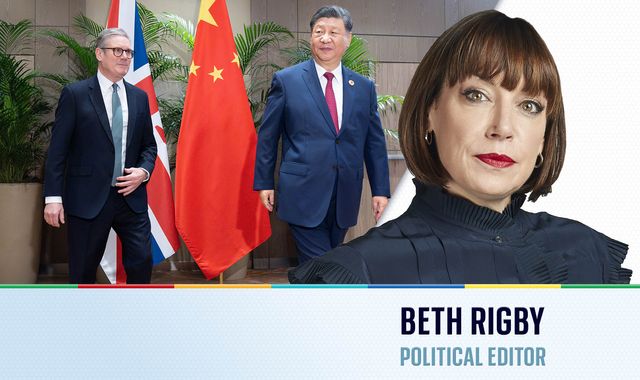
Keir Starmer's January has been the stuff of nightmares.
It kicked off with the crisis over Greenland and rift with Donald Trump - and was followed by a dose of psychodrama over the Labour leadership courtesy of Andy Burnham and that unwanted by-election.
This week will be another high-stakes one for the prime minister as he heads to China to look for deeper trade ties against the backdrop of a volatile US and domestic resistance to Beijing at home.
This visit has been a year in planning and will be a big symbolic moment, if rather ill-timed, given the troubles he's facing in his own backyard. Starmer will be the first UK prime minister to visit China since Baroness Theresa May in 2018.
His goal is to try to drum up trade with the world's second-biggest economy. He hopes this will help spur the economy and help Labour make an impact on the cost of living - now his number one priority for government.
Politics latest: Burnham rejects claim he was told about by-election block
His challenge is to navigate that while not triggering Trump. Just days ago, the US president threatened a 100% tariff on Canada if PM Mark Carney did a trade deal with Beijing.
He will also have to face down criticism at home as the political consensus hardens against China due to concerns over national security threats and human rights.
It's been over a decade since David Cameron hailed a "golden era" of close economic relations with China, as the UK hosted President Xi Jinping on a state visit.
Since that period, relations between the two nations cooled amid concerns over national security and Chinese espionage, China's alliance with Russia, human rights abuses of the Uyghur population, and the crackdown on democracy in Hong Kong.
The controversy around the government's approval of a Chinese mega-embassy last week - after years of delay - is a reflection of the deep unease many feel about an expanding Chinese footprint in the UK.
It has not been well received by Washington, which believes the embassy will allow widespread spying, and was opposed by a number of MPs across the House.
That is why this reset moment, spearheaded by Starmer, carries consequence. He must navigate both those economic opportunities while managing critical matters of national security and an increasingly fractious geopolitical backdrop.
In an interview with Bloomberg on the eve of his trip, the prime minister said he wanted to take a "more consistent" approach to China rather than "veering from a Golden Age to an Ice Age" as he insisted the UK did not have to compromise on national security to pursue business interests (those opposed to the mega-embassy disagree).
On the economic opportunities, the prize is clear: the UK wants to do more trade with the world's second-biggest economy, and the PM will be taking a delegation of 60 business and cultural leaders with him to that end.
China is already the UK's third-largest trading partner and supports 370,000 jobs. Starmer wants to do more.
In the global context, the reset with China will, of course, carry risk with President Trump, but the recent actions and behaviour of the US president, who sparked a national outpouring of anger after denigrating British servicemen who lost their lives fighting alongside US troops in Afghanistan, can only help the UK's cause when it comes to China.
Be it Trump's ambivalence over NATO, aggression towards Greenland, threats of tariffs or hostility to the UK European allies, the US has turned from the cornerstone of the post-war order to an unreliable ally.
In an increasingly tense space between two global powers, middle powers like the UK can no longer seek sanctuary under the umbrella of the US and need to navigate a more complex path: in recent months, the leaders of the EU and President Macron and Chancellor Merz have all beaten a path to President Xi's door.
For the PM's part, he insists the UK can maintain its relationship with its closest ally, the US, while pursuing trade opportunities with China, without being forced to choose between the two.
"I'm often invited to simply choose between countries. I don't do that," he told Bloomberg.
"We've got very close relations with the US, of course we want to, and we will maintain that business, alongside security and defence."
For China's part, it wants better access to UK markets, be that in investments or exports. It will also want to depoliticise a relationship that has in recent years been dominated by questions of security threats and the status of Hong Kong.
In a sign of the growing warmth between London and Beijing, officials said Starmer would work with China on illegal migration and more financial co-operation.
Starmer is sometimes in private rather prickly about the tag "never here Keir", and tells colleagues that these international trips are all about, and only about, delivering for the public - be it on trying to deal with illegal migration with the Germans or the French, or trying to put more money in the pockets of working people through seeing off the worst of Trump's tariffs or trying to drum up business.
Dealing with China will, of course, come with controversy and risks, leaving the impression that the prime minister cares more about globe-trotting than the domestic grind.
Read more:
Every Labour government U-turn to date
'Very deep poverty' hits 6.8 million in UK
Even as he prepares to fly to Beijing, the government this week is trying to highlight freezing prescription charges, announcing plans to cap ground rents - delivering on a manifesto pledge while also trying to placate MPs - and an £80m support package for pubs after the business rates backlash.
It's been hard for Starmer to make much progress on the cost of living message in between the drama of Trump and then Burnham, but government insiders tell me that, at last, polling is beginning to improve for Labour with people that are feeling the benefits of some of their cost of living initiatives, be it breakfast clubs, free childcare or their decision to lift the two child benefit cap.
For a prime minister acutely aware of his domestic fragility, with the public and his party, a five-day trip to China right now will do little to steady the nerves. There are many in the party mutinous over Starmer's decision to block Burnham from standing in the Gorton and Denton by-election.
The prime minister is not in a good place to try to lead from the front and charm in the tearooms when he is 5,000 miles away.
But as he struggles with the politics, he is pressing on with trying to secure some delivery on the pledges he made when he won the election.
His calculation is that more business with the world's second-biggest economy will help him do that - and could ultimately give him some much-needed help back home.

(c) Sky News 2026: Why Sir Keir Starmer's reset moment with China 'carries consequence'
 Local news content from CItiblog - read more at
  Warrington hospital's home birth service played 'Russian roulette' with lives, grieving father says
 Boy, 14, charged over fatal e-scooter crash in Manchester
 Crowds gather in Shetland for Up Helly Aa fire festival
 'What do you want from me?' Captain in fatal ship collision asks prosecutor
 Nathan Tokosi jailed after man shot in head, mouth and body in drive-by attack
 Sir Idris Elba caught speeding on moped a day after announcing Netflix movie about Charles's charity The King's Trust
 Rwanda suing UK over scrapped deportation scheme
 Hundreds of jobs lost as Revolution bars owner enters administration